Following a breakfast roundtable co-hosted by Unitary and Artex Risk, Sasha Haco, CEO and Co-founder at Unitary, and Zena Sandgrove, Operations Director at Artex Risk, share what London Market leaders said about why AI is proving difficult to scale — from narrow ROI expectations to the cultural and operational changes needed to make automation stick.
Earlier this month, we had the pleasure of co-hosting a breakfast roundtable in London where we brought together senior operations leaders from across the London Market.
The room included a broad mix of perspectives, from private equity-backed MGAs to established carriers and Lloyd’s operations. Despite the different business models and levels of maturity, many of the same operational challenges came up repeatedly.
The theme was operational excellence in a softening market, but the discussion quickly became very practical: with pressure increasing on profitability, efficiency and cost discipline, where can businesses remove non-value-add work now? And how can AI and automation deliver measurable value without becoming another multi-year transformation programme?
What struck us most was that nobody needed convincing that AI and automation matter. The harder question now is how to turn experimentation into tangible operational improvement.
Everyone is moving, but very few have scaled
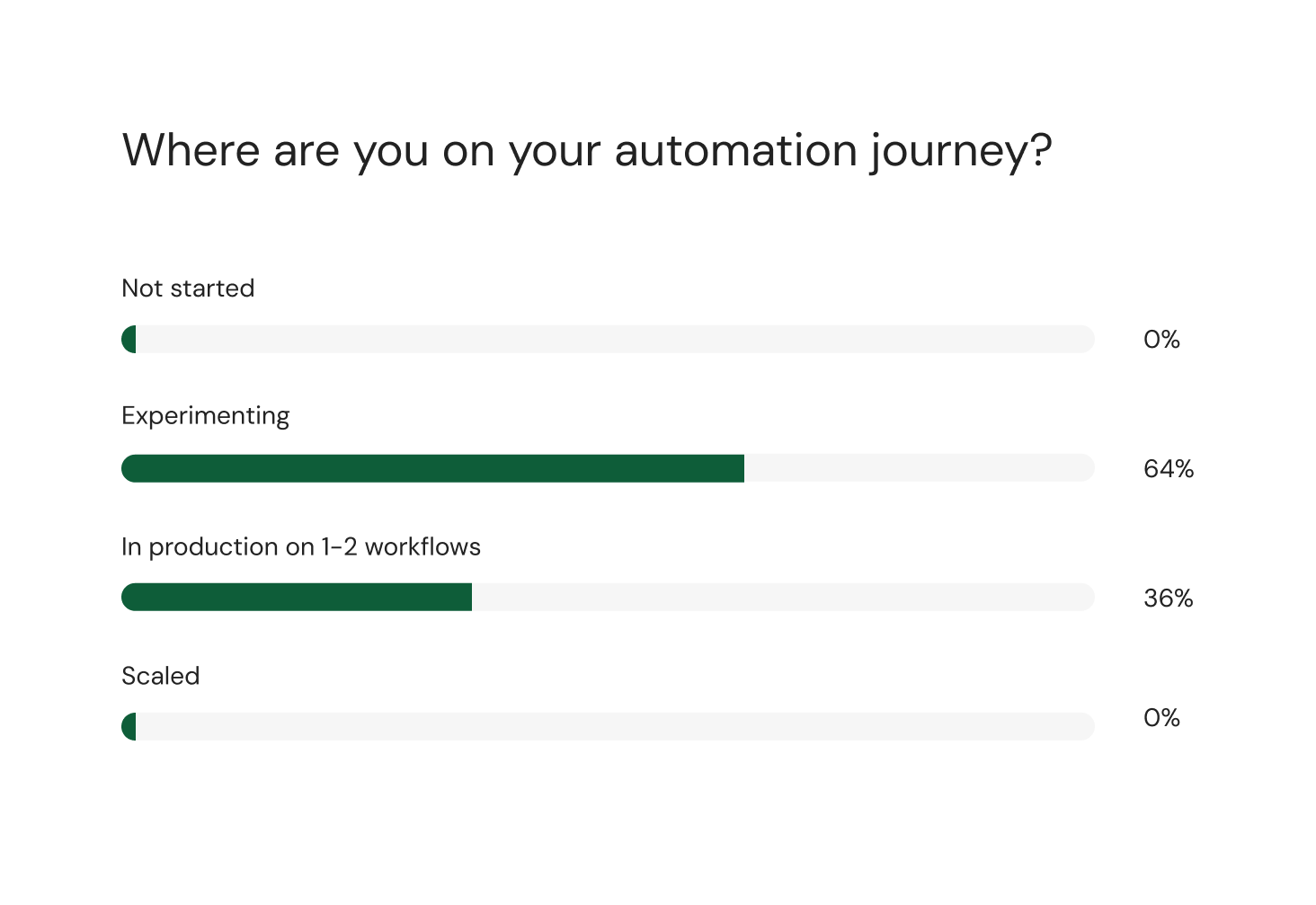
We asked attendees where they were on their automation journey. The results were quite telling: 64% said they were still experimenting, while the remaining 36% had one or two workflows in production. Nobody said they had not started, but equally, nobody felt they had meaningfully scaled.
It was one room on one morning, but it reflects what we hear in many conversations across the industry. There is no shortage of AI activity; the harder part is moving from isolated pilots and experiments to automation that becomes part of day-to-day operations.
We also asked what non-value-added activity was consuming the most capacity. The answers were strikingly ordinary: re-keying data, cross-referencing information across systems, reporting and collation, quality checking, data entry, enrichment and extracting information from long documents. Re-keying, reporting and collation, and cross-referencing or quality-checking data accounted for 86% of responses on the day.
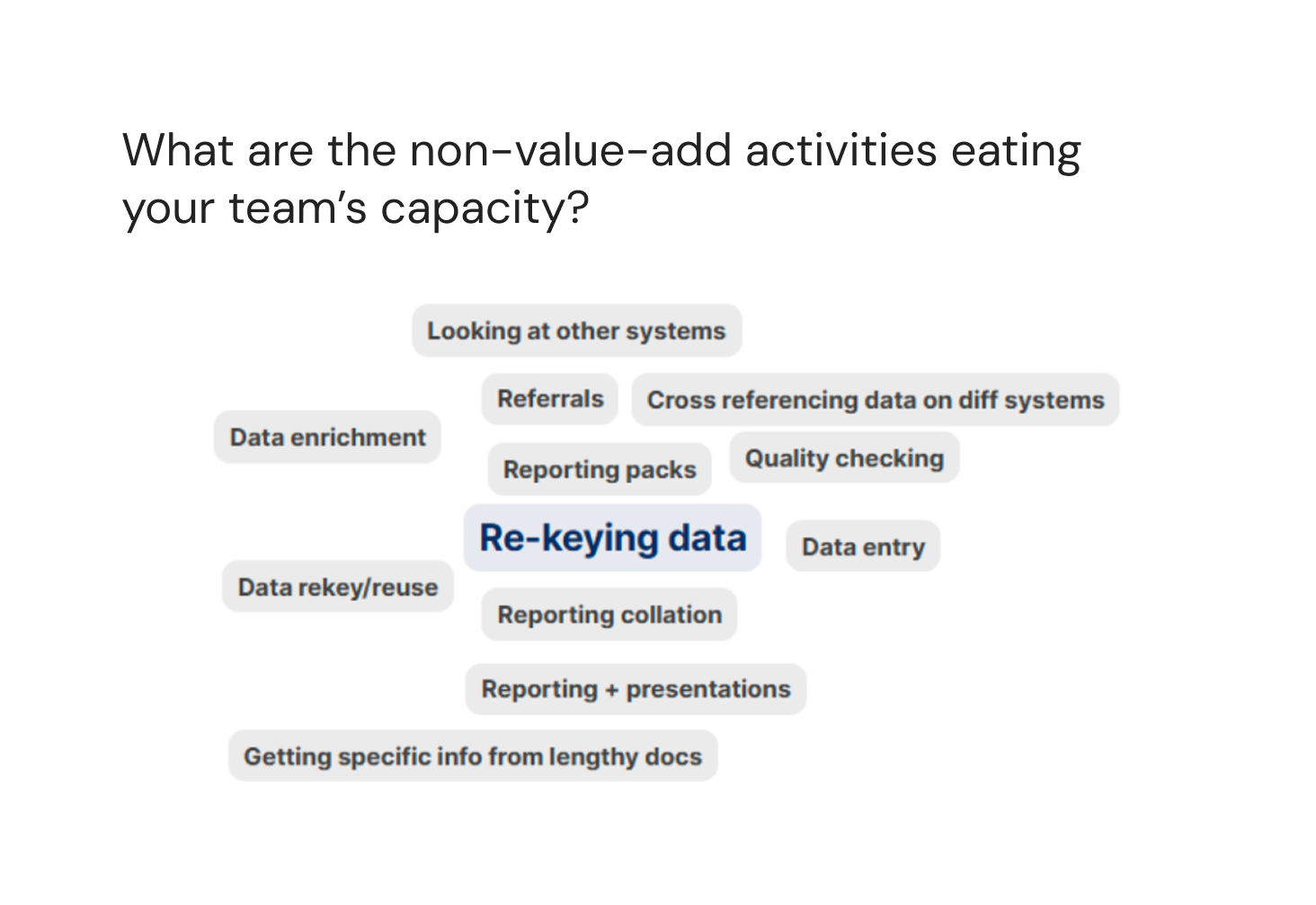
None of this is frontier AI. It is the repetitive operational work that sits between systems, documents and people every day. That suggests the problem is not a lack of suitable use cases. There is plenty of work that could be automated. The more difficult question is why so little of it has scaled.
Cost reduction is only part of the return
A lot of the discussion came back to ROI, but one of the most interesting points was that the usual way of calculating it may be too narrow.
Automation business cases are often centred on cost and capacity: how many hours can be saved, how much work can be removed, and whether that translates into a clear financial return. Those measures still matter, but in the London Market they will not always be enough on their own. Volumes can be relatively low, processes are often fragmented across teams and systems, and freeing up part of someone’s time does not necessarily translate neatly into removing cost.
As Zena put it:
“The biggest barrier to AI adoption in the London Market isn’t really the technology, it’s culture. If we keep trying to justify every project purely through cost and capacity reduction, the numbers often won’t stack up. The bigger return is in future-proofing the organisation - improving the experience for customers, making better use of people’s time and creating a business that the next generation actually wants to work in.”
That does not mean the return is not there. It means firms may need to look at value more broadly. There is value in giving customers and brokers a faster, more responsive experience, in freeing specialist employees from repetitive administration, and in building an organisation that can adopt new technology and new ways of working as the market changes. That is increasingly a competitive issue: the firms that modernise how they operate will be better placed to attract talent, meet rising customer expectations and adapt faster than those that do not.
The bigger barrier may be cultural
That broader question led to one of the strongest themes from the morning: the barrier to scaling AI is not purely financial or technological. A large part of it is cultural.
Automation changes how work gets done. It asks teams to trust software with tasks they may have carried out manually for years, and it forces organisations to be clearer about where human judgement is genuinely needed and where work is being done by a person simply because that is how it has always been done.
It also changes what teams need to know. People do not need to become AI engineers, but they do need enough understanding to work effectively with automation, challenge it when something looks wrong and know when human intervention is required. That means training and upskilling the people who will own these workflows and, in some cases, bringing in expertise that does not yet exist internally.
The discussion around accuracy brought this into focus. Automated processes are often held to a higher standard than manual work. People make mistakes when they re-key data or move information between systems, and organisations already build controls around that reality. When automation makes an error, however, it can quickly be treated as a failure of the technology itself.
Some of that caution is justified, particularly because automation can operate at a much greater scale. But the quality of the output also depends on the process behind it. If different people complete the same task differently, exceptions are undocumented or nobody agrees what should happen in an edge case, automation will expose those problems very quickly. In that sense, automation can reveal weaknesses that already exist in the underlying process rather than create them.
Start small, prove it, then build from there
We ended the morning by asking attendees what had shifted in how they thought about AI risk and opportunity. Around 80% came back to some version of the same idea: start small, move quickly, test and focus on practical wins.
That does not mean lowering the ambition to automate. It means starting with one contained workflow where the problem is clear, the work is repetitive and the outcome can be measured. Understand how it operates today, decide what you want to improve, automate it and use the result to decide what comes next.
As Sasha put it:
“You don’t scale AI by trying to automate everything at once. You scale it by getting something genuinely useful into production, proving it works, and repeating that process. Five workflows that people actually rely on are worth far more than fifty experiments.”
The first project does not need to transform the whole organisation. Its value is partly in proving that the technology works, but also in showing that the business can change how work gets done, put the right governance around it and build confidence from something real.
In a softening market, the pressure to demonstrate value is only going to increase. But the lesson from the room was not simply to find the automation project with the biggest cost-saving number attached to it. It was to start with something useful, prove it in practice, and use each success to build the skills, confidence and culture needed to go further.
Co-authored by Sasha Haco and Zena Sandgrove